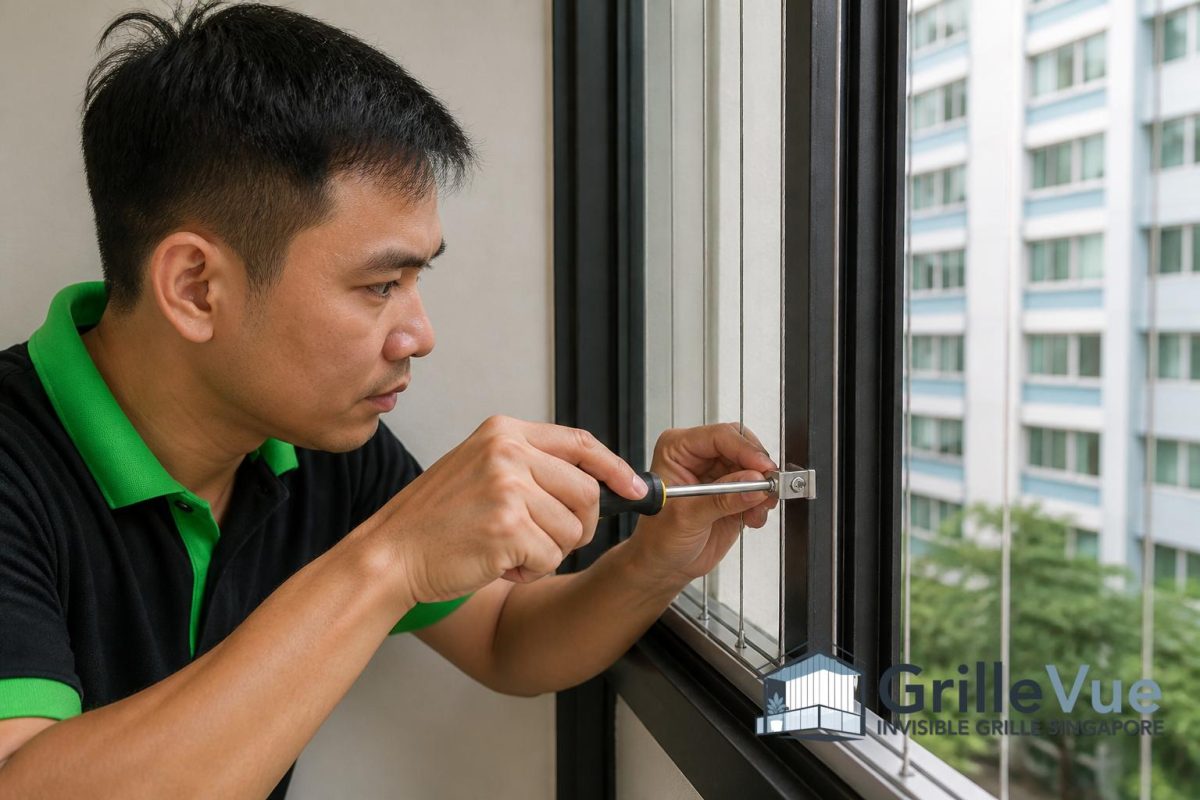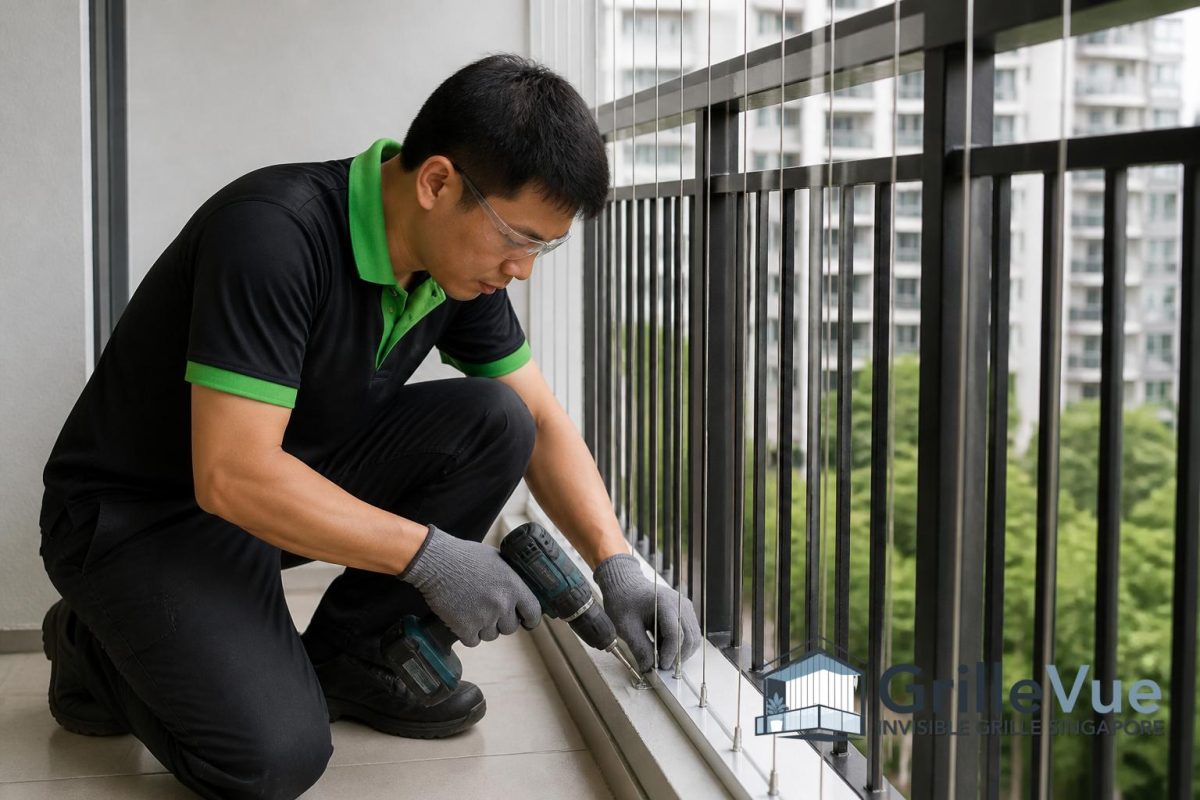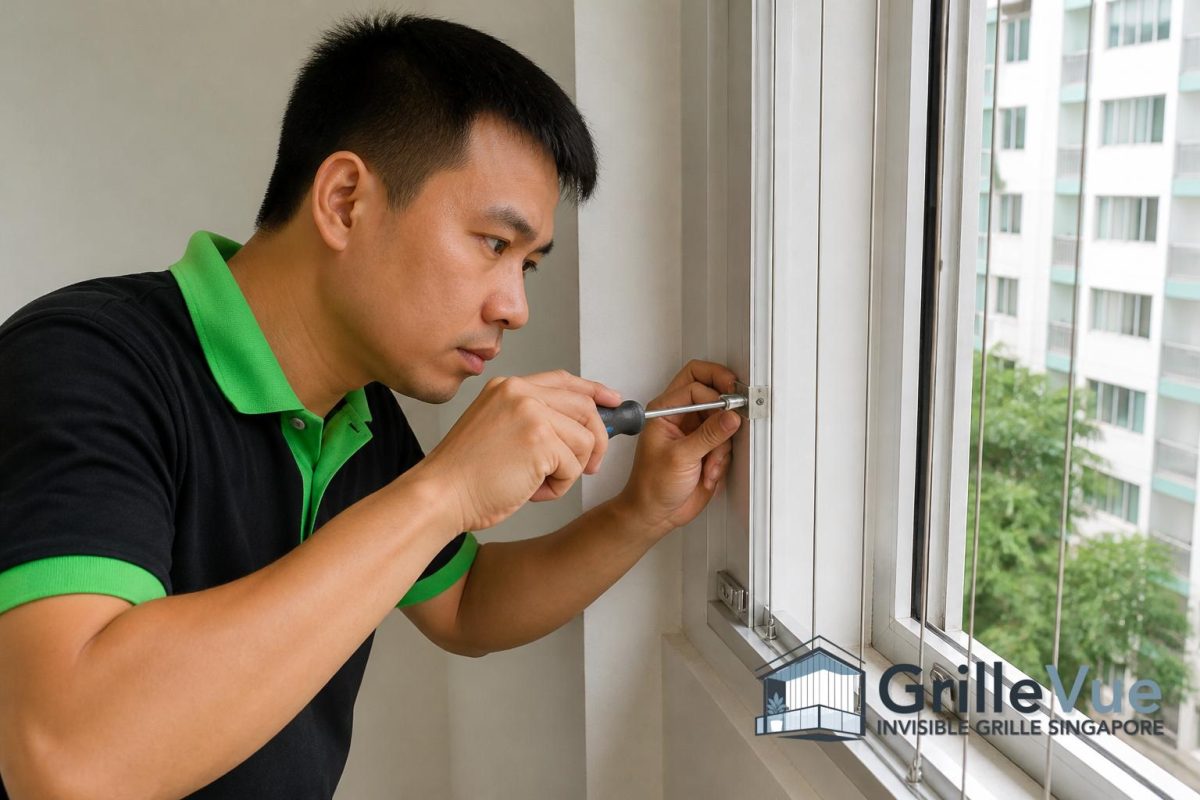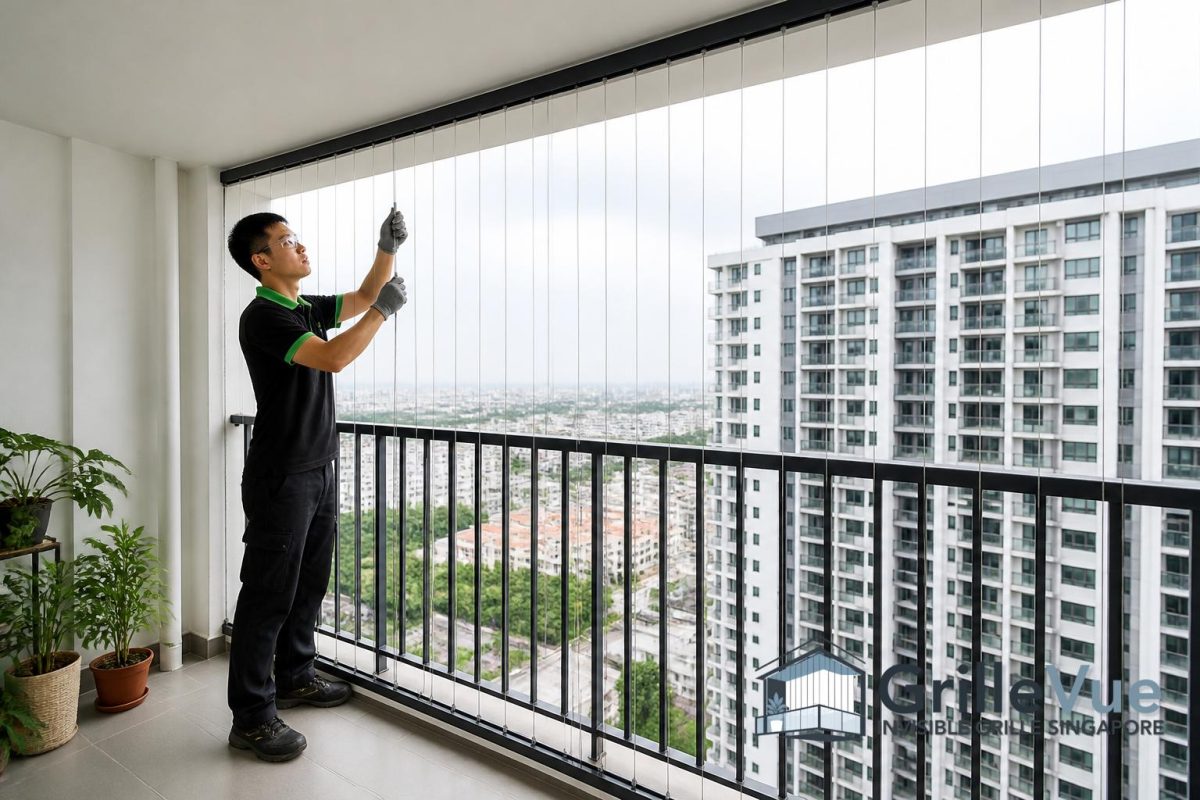
After an invisible grille is installed, what actually keeps the cables secure is not just the cable itself, but the whole fixing system behind it: the anchor points, the support frame or mounting surface, the correct tensioning method, and the quality of the final checks. In Singapore homes, whether the grille is fitted to an HDB window, a condominium balcony, or a landed-home opening, the long-term security of the system depends on how well each part is matched to the site and how carefully the installer sets it up.
What Holds Invisible Grille Cables in Place
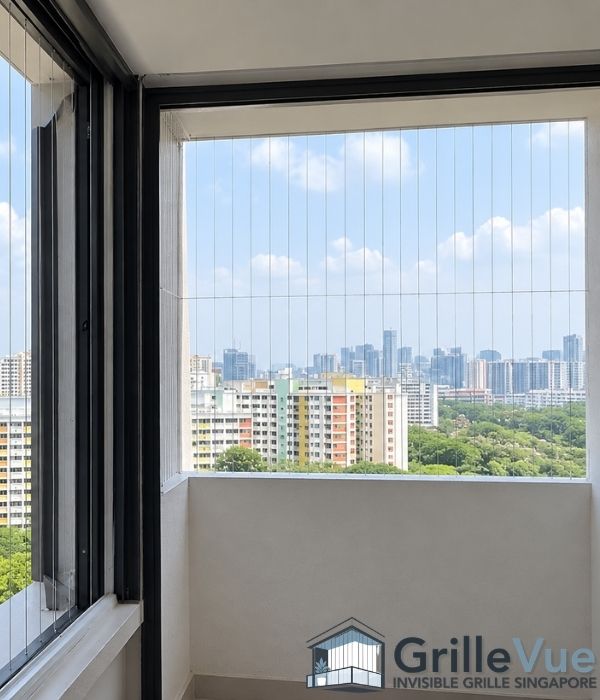
An invisible grille is made up of fine tensioned metal cables stretched across a window or balcony opening. These cables are secured at each end to fixing points that must be firmly anchored to the surrounding structure. If the fixing points are not suitable, the cables may not remain evenly tensioned over time.
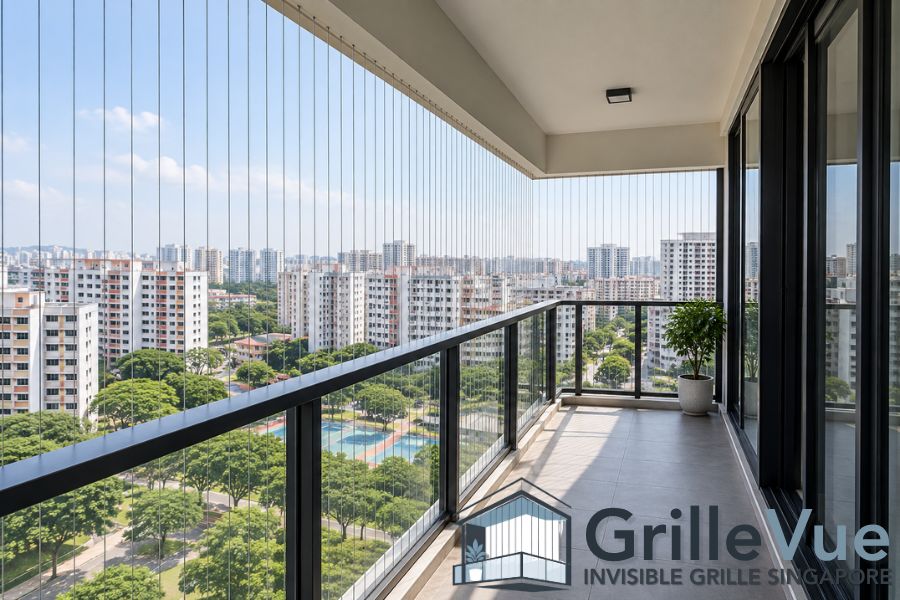
The key parts are the cable, the end fittings, and the surfaces they are anchored into. On a window opening, this may involve the window frame area and its available fixing zones. On a balcony opening, the installer must consider the balcony edge, columns, walls, or other structural points that can take the load. The exact arrangement depends on the site and the product design.
Why the Opening Type Matters
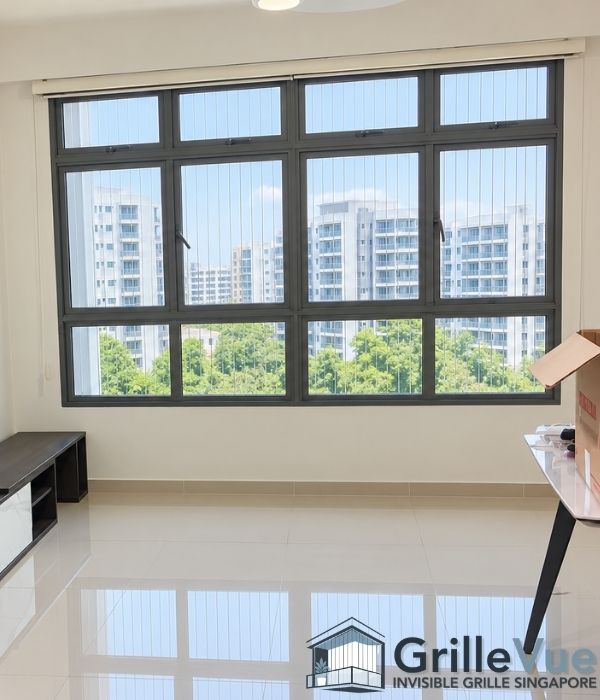
The answer to cable security is not the same for every home. A small HDB window opening usually has different fixing constraints from a full-height condominium balcony or a landed-property patio edge. Each opening has its own framing, depth, and access conditions, which influence where the cables can be anchored and how they can be tensioned.
For an invisible window grille, the installer normally focuses on the window aperture and surrounding frame. For an invisible balcony grille, the priority is the balcony opening, access from inside and outside, and safe fixing to appropriate structural points. The opening’s shape and dimensions matter because the grille has to be tensioned evenly without forcing the cables into awkward angles.
The Role of Proper Measurement and Layout
Before installation, the opening should be measured carefully so the cable lines, spacing, and fixing points are planned properly. This is one of the biggest factors in whether invisible grille cables stay secure after installation. Accurate measurement helps the installer position the cables so they are straight, evenly spaced, and suited to the geometry of the opening.
If the layout is rushed, the installer may need to compensate on site with uneven spacing or suboptimal anchor placement. That can affect tension and appearance. For Singapore homes, especially where windows or balconies may have irregular edges, ledges, or existing fixtures, a proper site assessment is just as important as the cable material itself.
How Tension Keeps the Cables Stable
Invisible grille cables are designed to work under tension. Once fixed, they are tightened so they remain firm across the opening and do not sag excessively. The tensioning process is what helps the grille maintain its shape and function after installation.
However, tension is not something that should be pushed to an extreme. Too little tension can leave the cables loose; too much can place unnecessary stress on the fittings and mounting points. A careful installer will balance the tension and then check it again after the full run has been completed.
What Good Fixing Points Look Like
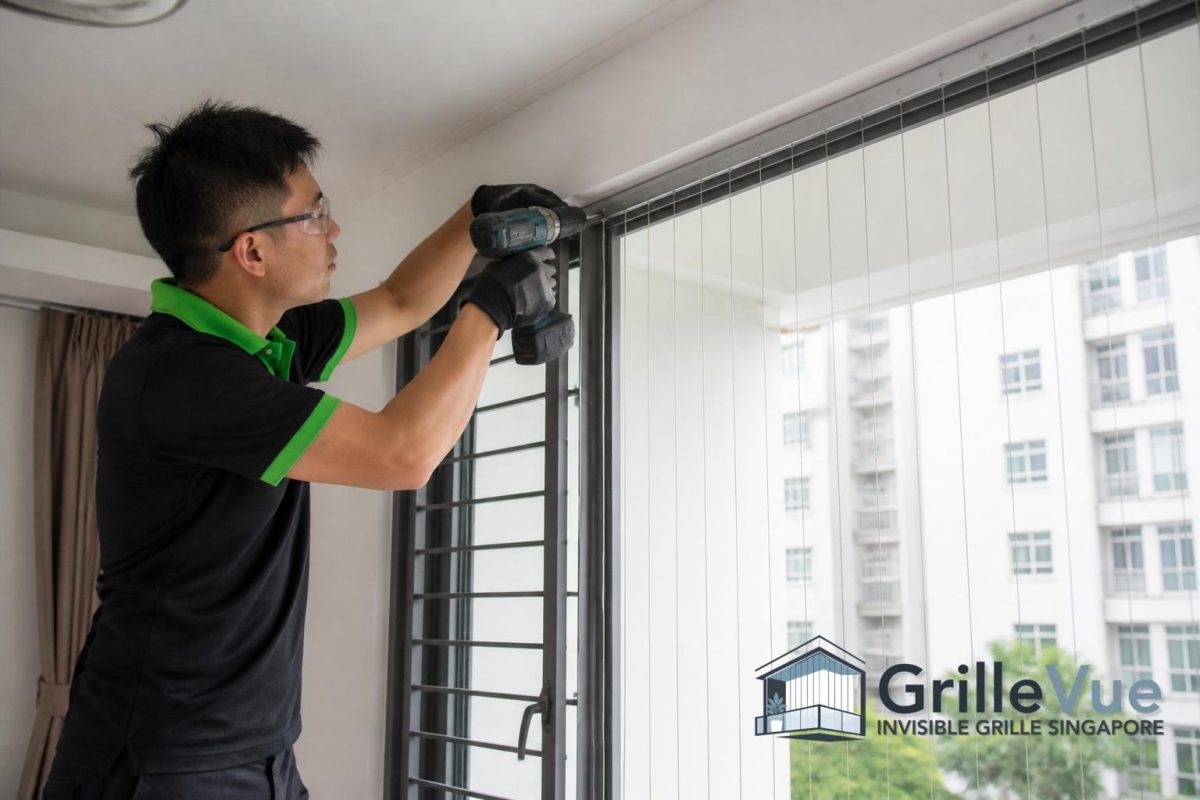
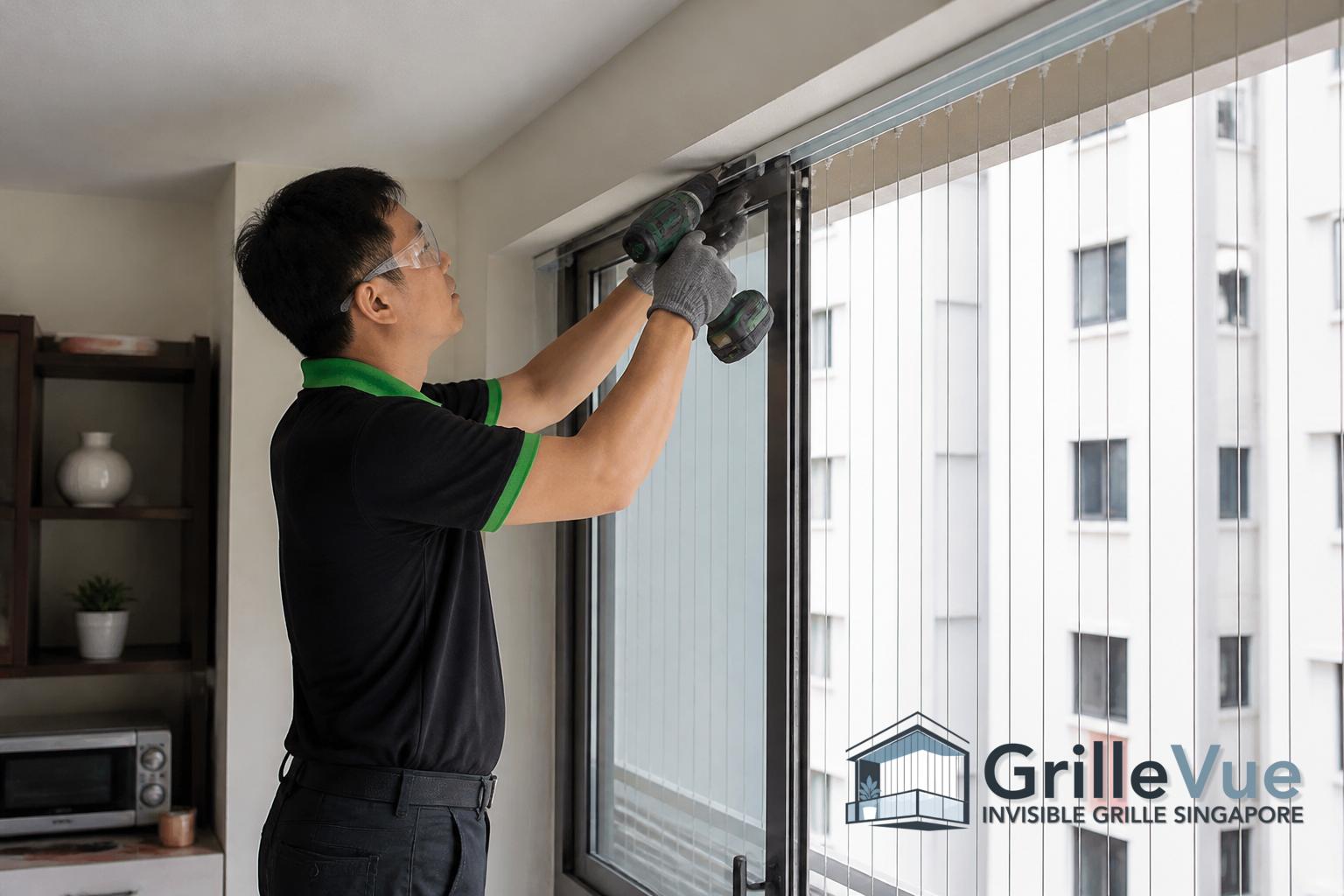
Secure invisible grille cables rely on fixing points that are suitable for the structure they are attached to. In practical terms, that means the installer must identify surfaces that can support the load and remain stable over time. The hardware used at each fixing point should match both the cable system and the substrate.
This is where experience matters. For example, a balcony grille installation may need different anchoring from a window grille installation because of the opening width, exposure, and the way people move around the area. The installer should check that each end fitting is seated correctly and that the cable line remains consistent across the span.
Checks That Help the Cables Stay Secure After Installation
Once the invisible grille has been fitted, several checks help confirm that the cables are secure. These usually include inspecting the alignment of the cable runs, confirming the tension across the opening, and ensuring the end fittings are properly fastened. A neat-looking finish is useful, but the more important point is that the fixing system is stable and evenly loaded.
Over time, a homeowner may also notice minor changes due to building movement, usage, or environmental conditions. In Singapore’s humid climate, periodic inspection is sensible. If a cable starts to feel less firm or shows visible misalignment, it is worth asking the installer to assess whether the tension or fittings need adjustment.
Maintenance That Supports Long-Term Security
Invisible grilles do not usually require complicated maintenance, but they do benefit from simple visual checks. Homeowners can look for loose fittings, uneven cable spacing, or signs that the grille has been stressed by an impact or by repeated use around the opening. Keeping the area around the cables clean also helps the system remain easy to inspect.
For window openings, check that no additional fixtures have been added that interfere with the grille lines. For balcony openings, avoid hanging heavy items from the cables or using them as support points. Invisible grille cables are safety barriers, not load-bearing rails, and they should be treated accordingly.
Differences Between Invisible Grilles and Zip Track Blinds
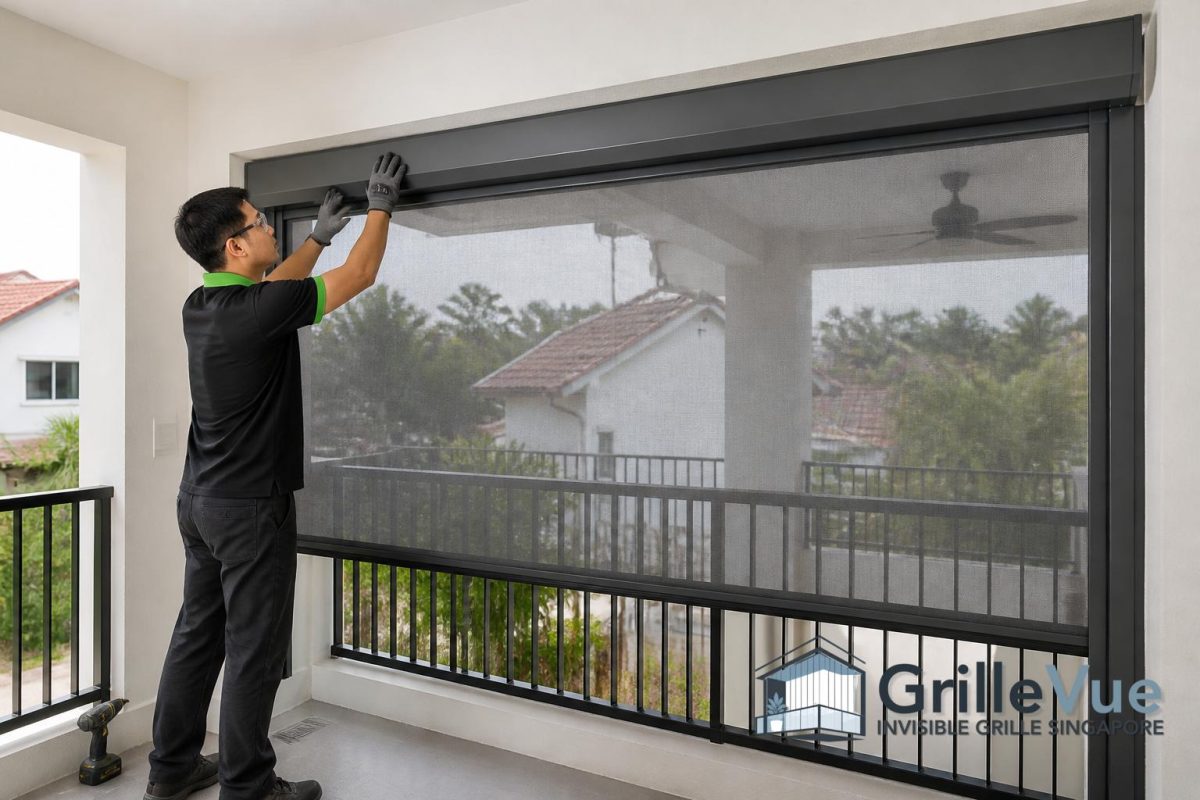
It is important not to confuse invisible grille cables with Zip Track, Zip Trak, Ziptrak, or Zipblinds systems. Invisible grilles use tensioned metal cables fixed across a window or balcony opening for safety and visibility. Zip Track blinds are guided outdoor screen systems with a headbox, side tracks, fabric, and a bottom bar.
Because the mechanisms are different, what keeps them secure is different too. For invisible grilles, the focus is on anchor points and cable tension. For Zip Track blinds, the important details are the side-channel alignment, fabric choice, bottom-bar tracking, and, in motorised versions, the motor and power connection. They solve different needs and should be evaluated separately.
If you are checking an existing installation or planning a new one, WhatsApp GrilleVue Invisible Grille Singapore – Windows & Balconies with your property type, approximate opening dimensions, existing fixtures, and whether you need an invisible grille, manual Zip Track blinds, or motorised Zip Track blinds for assessment and quotation: Send WhatsApp enquiry
Conclusion
What keeps invisible grille cables secure after installation in Singapore homes is a combination of correct measuring, suitable fixing points, proper tensioning, and careful final checks. The cables themselves are only one part of the system. The opening type, whether it is an HDB window, a condominium balcony, or a landed-home space, shapes how the grille should be anchored and adjusted.
For homeowners, the most useful approach is to ask how the installer plans to fix the cables, what points will be used for anchoring, and how tension will be checked after installation. That gives a clearer picture of long-term security than looking at the cables alone.
Choose GrilleVue Invisible Grille Singapore – Windows & Balconies
GrilleVue Invisible Grille Singapore specialises in residential grille and balcony solutions that help homeowners improve safety and make better use of windows and outdoor areas without unnecessarily enclosing the space. We provide invisible grille, invisible window grille, invisible balcony grille, window grilles, and balcony grille installations for HDB flats, condominiums, and landed properties, with each solution planned around the opening, layout, and requirements of the home.
Our other services also cover Zip Track and Zip Track blinds for homeowners who want greater control over balcony and outdoor areas. An invisible grill for the balcony can help retain visibility while adding a safety barrier, while zip track blinds can provide a more sheltered and adaptable space depending on weather conditions and daily use.
For more information on suitable window and balcony solutions, explore our blog for useful guides or browse our completed projects for examples of previous installations. Contact us via WhatsApp at +65 8241 0032 to discuss your home, installation needs, and available options.
Frequently Asked Questions
Do invisible grille cables need to be re-tensioned over time?
Sometimes, yes. Depending on the opening, the fixing surface, and everyday wear, cables can gradually lose some tension or appear less even. A periodic visual check is sensible, especially if the grille is installed at a frequently used window or balcony opening.
Are the cable fixing points the same for windows and balconies?
Not always. Window openings and balcony openings usually have different structural constraints, access conditions, and layout requirements. An invisible window grille may use different anchor positions from an invisible balcony grille because the span and surrounding structure are not the same.
Can invisible grille cables be used as a support rail?
No. Invisible grille cables are safety cables, not load-bearing supports. They should not be used to hold body weight, hang heavy items, or act as a substitute for a proper handrail or structural barrier.